
Used Aircraft Quality: Why Manufacturing Date and Flight Hours Don't Tell the Whole Story
When evaluating a used aircraft, two of the first data points buyers typically examine are its manufacturing date and total accumulated flight hours. These figures are easy to compare, readily available, and often used as primary indicators of aircraft value and condition.
However, relying too heavily on either metric can lead to an incomplete assessment of an aircraft's true condition and operational value.
A newer aircraft is not necessarily a better aircraft. Likewise, an aircraft with fewer flight hours is not automatically in better condition than one with higher utilization.
For military and commercial operators considering used helicopters, particularly established platforms such as the UH-60 Black Hawk, understanding the distinction between chronological age, accumulated flight hours, and actual aircraft condition is essential to making an informed acquisition decision.
Manufacturing Date: Understanding Chronological Age
The manufacturing date establishes an aircraft's chronological age. It provides useful context regarding the aircraft's original design configuration, production standards, installed equipment, and potential exposure to aging-related deterioration.
However, chronological age alone does not establish aircraft quality.
An aircraft manufactured 30 years ago may have spent much of its service life in controlled storage, operated under moderate conditions, and received consistent maintenance. Another aircraft manufactured 15 years ago may have accumulated significant operational stress, experienced demanding environmental conditions, or received inconsistent maintenance.
Age-related considerations include:
Corrosion and environmental exposure.
Material fatigue and deterioration.
Aging electrical wiring, connectors, and insulation.
Rubber components, seals, hoses, and other time-sensitive materials.
Obsolescence of avionics and installed equipment.
Compliance with applicable service bulletins, modifications, and airworthiness requirements.
These factors must be evaluated independently of the manufacturing date.
An older aircraft with a documented maintenance history, appropriate preservation, and a comprehensive inspection may represent a better acquisition than a newer aircraft with an incomplete maintenance history or unresolved technical deficiencies.
Flight Hours: Understanding Aircraft Utilization
Total flight hours are another commonly used indicator of aircraft condition. They provide a measure of accumulated utilization and are particularly relevant when evaluating the remaining service life of major components and structural assemblies.
However, flight hours do not tell the entire story.
Two aircraft with identical accumulated flight hours may have experienced very different operating conditions.
For example, an aircraft primarily conducting long-duration transportation missions may accumulate flight hours with relatively few engine starts and operating cycles. An aircraft conducting short-duration training, utility, or tactical missions may accumulate the same number of hours while experiencing substantially more starts, shutdowns, landings, and operating cycles.
Other factors that influence aircraft wear include:
Operating environment, including temperature, humidity, dust, and salt exposure.
Mission profile and frequency of high-demand operations.
Number of starts, landings, and operating cycles.
Loading conditions and mission equipment configurations.
Maintenance practices and inspection intervals.
Quality of maintenance personnel and technical oversight.
For this reason, flight hours should be evaluated alongside aircraft utilization history, component hours, cycle counts, and maintenance records.
The Importance of Maintenance History and Aircraft Records
Perhaps the most important factor in determining the quality of a used aircraft is the completeness and credibility of its maintenance history.
An aircraft's records provide insight into how it was operated, maintained, inspected, modified, and preserved throughout its service life.
A thorough records review should consider:
Historical maintenance and inspection documentation.
Major component replacement and overhaul history.
Structural inspections and repairs.
Corrosion findings and corrective actions.
Applicable service bulletins and mandatory directives.
Military modifications and engineering change records.
Accident, incident, and damage history.
Aircraft preservation and storage documentation.
Current component life limits and remaining service life.
For military aircraft, historical maintenance records can be particularly valuable because they may provide a detailed account of maintenance actions, component replacements, modifications, and applicable military airworthiness requirements.
The ability to trace an aircraft's maintenance history is an important element of acquisition risk assessment.
A More Meaningful Approach: Evaluate the Complete Aircraft
Rather than relying on manufacturing date or total flight hours as standalone measures of quality, buyers should evaluate an aircraft using a combination of factors.
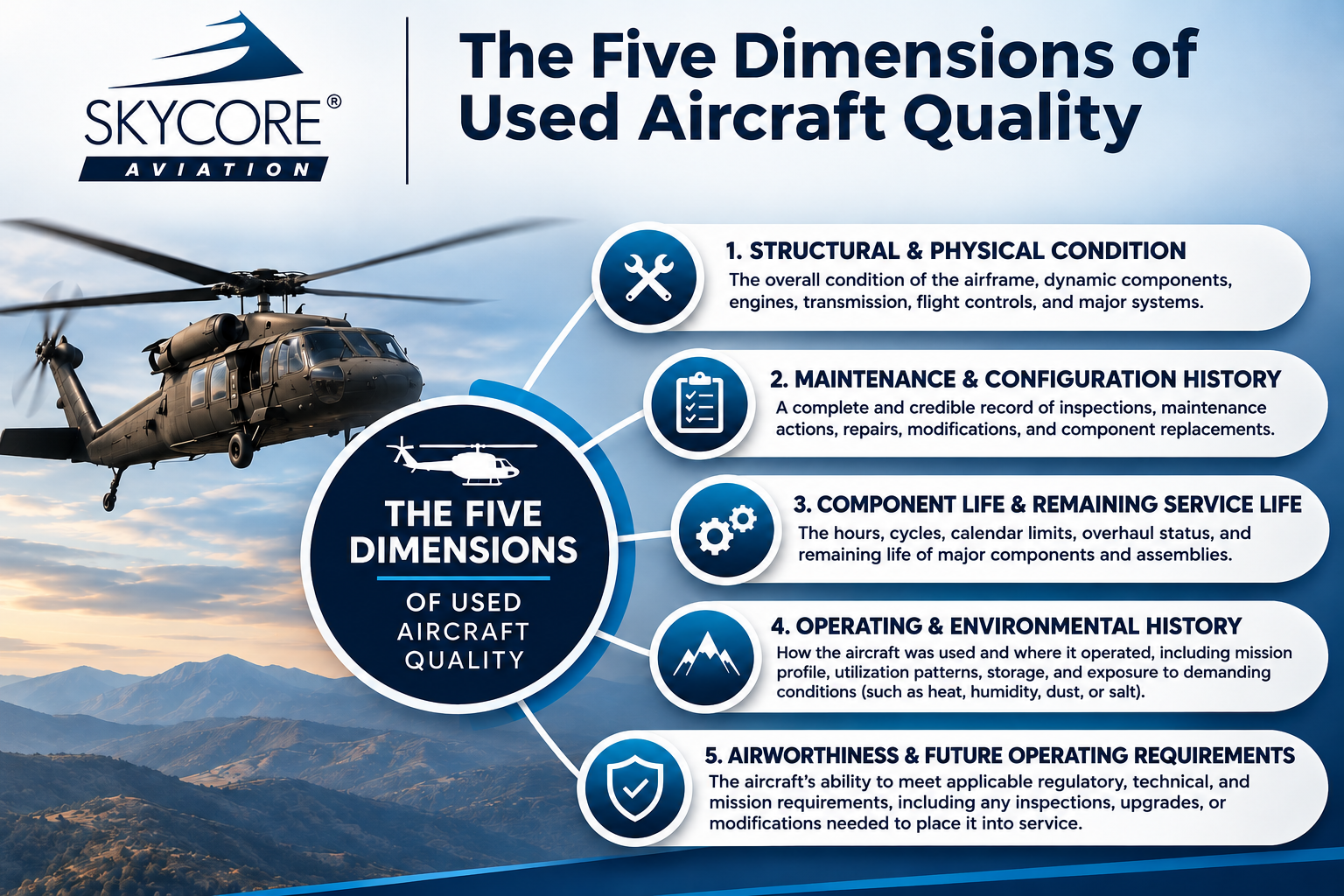
A practical acquisition assessment should consider five dimensions areas:
1. Structural and Physical Condition
Evaluate the airframe, dynamic components, engines, transmission systems, flight controls, and other major assemblies through appropriate inspections and technical assessments.
2. Maintenance and Configuration History
Review historical records, modifications, repairs, component replacements, and the aircraft's maintenance program.
3. Component Life and Remaining Service Life
Examine the individual hours, cycles, calendar limits, overhaul status, and remaining service life of major components. Total aircraft hours alone cannot establish component condition or remaining life.
4. Operating and Environmental History
Understand the aircraft's mission profile, operating environment, utilization patterns, storage conditions, and exposure to demanding operational environments.
5. Airworthiness and Future Operating Requirements
Determine whether the aircraft can meet the intended operator's regulatory, technical, mission, and certification requirements. Consider the modifications, inspections, and upgrades necessary to place the aircraft into service.
The Bottom Line: Condition Matters More Than Age or Hours Alone
Manufacturing date and accumulated flight hours are important starting points when evaluating a used aircraft. They provide useful information and should never be disregarded.
But neither metric independently determines aircraft quality, reliability, or remaining useful life.
A well-maintained, properly preserved aircraft with higher accumulated hours may offer a better acquisition opportunity than a newer, lower-hour aircraft with incomplete records, deferred maintenance, or significant component-life limitations.
The objective should not simply be to acquire the newest aircraft or the aircraft with the fewest hours. It should be to identify the aircraft that offers the best combination of structural condition, maintenance history, configuration, remaining component life, airworthiness, and suitability for its intended mission.
At Skycore Aviation, we believe successful aircraft acquisition begins with understanding the complete aircraft—not just the numbers on its data plate or flight-hour records.
Skycore Aviation | Aircraft Acquisition. Modernization. Maintenance. Operational Support.